Quick Summary
|
Parent Question |
Answer |
|
Do pediatricians recommend one specific automatic cradle? |
Generally, no. Product choice depends on design, intended use and safety requirements. |
|
Can automatic rocking soothe a baby? |
Gentle movement may be soothing for some babies, but it doesn't replace safe sleep practices. |
|
Can every automatic cradle be used for infant sleep? |
No. Check the product's specific intended use and safety instructions. |
|
What is recommended for routine sleep? |
A firm, flat, non-inclined sleep surface designed for infants. |
|
Should babies sleep in swings? |
Routine sleep in swings and similar seating devices is not recommended. |
|
What should parents check? |
Age, weight, construction, instructions, recalls and intended use. |
Table of Contents
- Do Pediatricians Recommend Automatic Baby Cradles?
- What Pediatricians Focus on Instead
- Can Automatic Cradles Help Soothe Babies?
- Automatic Cradle vs Safe Sleep Space
- What Makes a Baby Cradle Safer?
- What Parents Should Check Before Buying
- TinyTyke Automatic Baby Cradles
- Common Questions Parents Ask Baby
- Cradle Safety
- Checklist Key
- Takeaways
- FAQs
Do Pediatricians Recommend Automatic Baby Cradles?
However, when parents feel tired after several sleepless nights, an automatic baby cradle is very tempting.
Nevertheless, the following question arises:
"Are pediatricians recommending automatic baby cradles?"
And there is not a straightforward answer of yes or no.
Mostly, the pediatric organizations concern themselves with the way infants sleep and with the safety of the infant sleeping environment, but do not make any recommendations regarding a specific type of cradle or motorized equipment.
The American Academy of Pediatrics advises babies to sleep on their backs on a firm, flat, and non-inclined surface.
According to the recommendations of the U.S. Consumer Product Safety Commission (CPSC), the infant sleeping products should be distinguished from products intended for infant swinging.
What Do Pediatricians Focus on Instead?
Instead of:
"What automated cradle would a pediatrician advise?"
It might be more appropriate to ask:
"Do I have a product here which has features that will ensure safe baby care?"
Some things to keep in mind include:
1. Safe Sleeping Area
For regular baby sleeping, pediatric recommendations suggest using a firm and flat surface without inclinations with no loose objects.
2. Babies' Positions
Babies should be laid down on their backs while sleeping.
3. Intended Use of the Product
Parents need to carefully follow the manufacturer’s instructions to see what the product is supposed to be used for.
4. Age and Weight Limitations
Never use a cradle above its recommended limitations.
5. Condition of the Product
Regularly check the condition of the frame, suspension, motor, fasteners, and fabric.
Can Automatic Cradles Help Soothe Babies?
Gentle rocking of babies is usually done by their parents as a means of comforting them.
There is an automatic system that makes it easier since the parent will not have to do the rocking manually.
This is because soothing and sleeping are two separate things.
Even though an invention may help in soothing, it does not necessarily mean that it is good for regular sleeping without any supervision.
Automatic Cradle vs Safe Sleep Space
This is one of the most crucial parts for the parents.
A Product Can be Used for Comforting
Parents can use a suitable cradle for providing movements based on the guidelines provided by the manufacturer.
However, Routine Sleep of Infants Requires Certain Conditions
The recommendations are as follows:
Sleeping position is back
Flat, firm, and non-inclined surface
Fitted sheet only
No use of pillows
No blankets
No stuffed animals and other soft objects
Individual sleeping space for infants
Conclusion:
It is wrong to think that "automatic," "electric," or "rocking" always means "safe for routine sleep." Always check for each products.
Are Automatic Baby Cradles Safe for Newborns?
Safety is relative to the individual cradle.
Parents should ensure that prior to buying or operating a motorized cradle they have:
Frame Sturdiness
Is the frame steady during usage?
Suspension Structure
Are the hooks, hanging devices and attachment devices sturdy?
Motor
Is there a motor made specifically for this product?
Motion
Are there instructions for suitable motion?
Weight Capacity
Is your baby within the stated weight range?
Age Limits
Is this cradle meant for the baby's age level?
Electrical Safety
Are the adapter and wiring suitable and undamaged?
Manuals
Are there manuals with the cradle about how to set up and use it?
Recall Information
Has this specific model or a similar cradle been recalled before?
Parents Should check for any recalls, even those of second hand nursery products.
What Makes a Baby Cradle a Better Choice?
When comparing automatic baby cradles, parents can use this checklist:
|
Feature |
Why It Matters |
|
Stable frame |
Helps maintain structural stability |
|
Secure suspension |
Reduces risk of detachment |
|
Controlled motion |
Helps prevent excessive movement |
|
Clear age/weight limits |
Helps ensure appropriate use |
|
Good instructions |
Reduces setup and use errors |
|
Durable materials |
Supports long-term use |
|
Washable fabric |
Makes hygiene easier |
|
Warranty |
Provides after-sales support |
|
Replacement parts |
Helpful for long-term maintenance |
|
Recall information |
Helps parents make informed decisions |
What About Automatic Baby Swings?
This is when things get complicated with product categories.
An Automatic baby swing and a motorized cradle may both offer movement but their designs might be completely different.
In most cases, swings keep babies in sitting or lying positions.
It is advised not to put babies to sleep in a seating device like a swing for sleeping.
Sleeping on inclined devices such as swings, rockers and gliders is a no-no.
Therefore, one cannot select a product just because it is motorized or labeled "sleep-friendly".
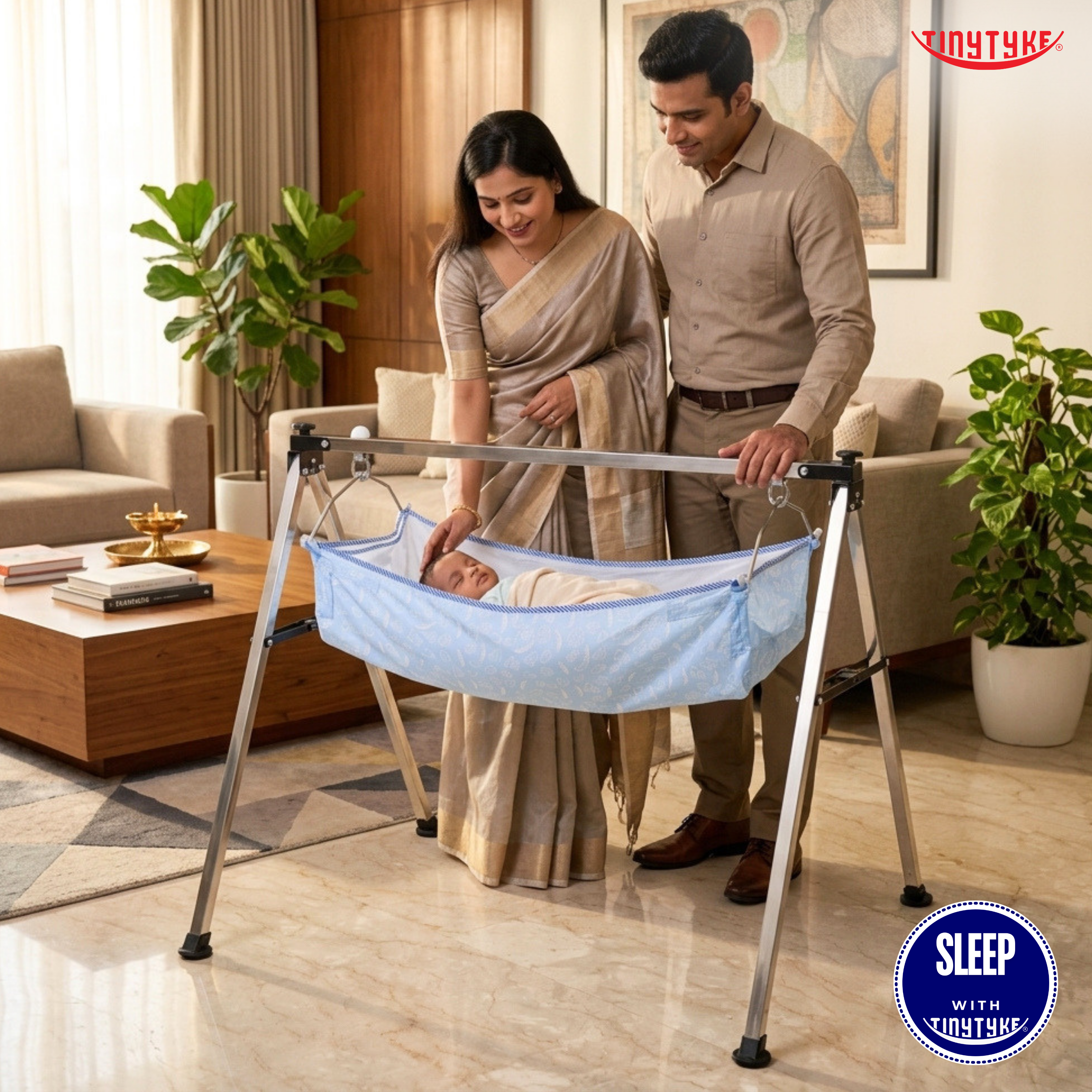
What About Traditional Jhula or Ghodiyu?
Traditional Indian cradles have been used for generations in families.
Modern automatic cradle systems incorporate the motorized mechanism to the traditional design.
If you plan on installing an automatic mechanism to a traditional jhula, you need to ensure that:
Your cradle is compatible with the automation mechanism.
Your stand is stable.
The motor has been installed following the manufacturer’s instructions.
The suspension mechanism is secure.
The weight limit is maintained.
No unauthorized alterations have been made.
TinyTyke Automatic Baby Cradles
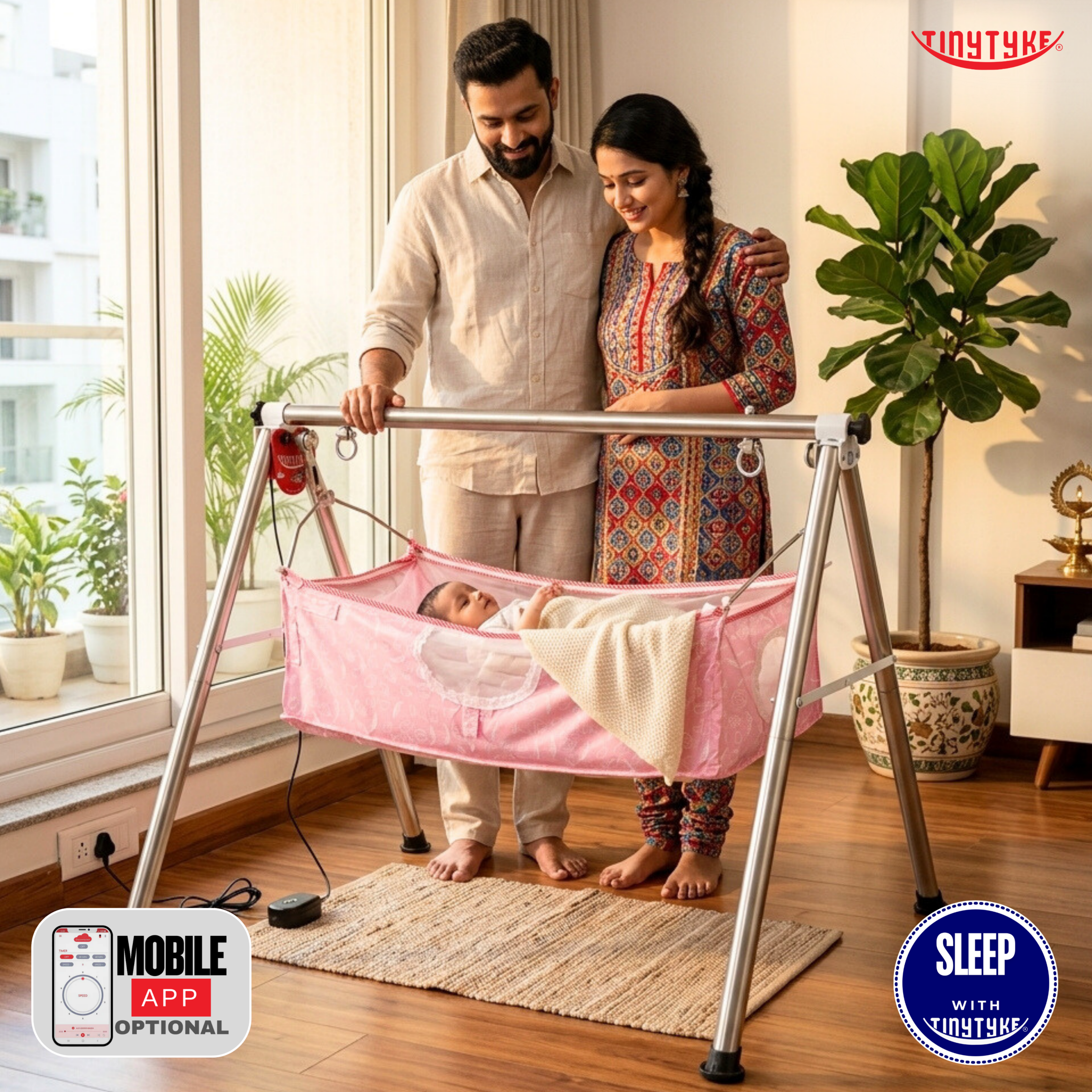
TinyTyke provides both manually operated as well as automated cradles that are based on the concept of traditional Indian cradles.
Depending on the model chosen, some of the features of TinyTyke automated cradles are:
- Adjustable automated rocking
- Folding frame option
- Washable material used in the making of the hammock
- Power-bank friendly option
- App controlled option available in some models
- Various other frame types
Product features like these have been provided for convenience sake, but features of any product must never be considered a substitute for health advice or safe sleep guidelines.
TinyTyke’s Approach
The most appropriate approach to choosing a baby cradle is certainly not asking the question:
"Which cradle is prescribed by a pediatrician?"
Rather, one must ask:
"Is this the right product for my child?"
When Should Parents Ask Their Pediatrician?
The following are some situations where consulting a pediatrician would be very useful to you:
Trouble sleeping on a regular basis
Difficulty falling asleep as well as feeding
Poor growth
Excessive sleepiness
Problems breathing
Reflux
Concerns regarding development
Suddenly changing your baby’s sleep pattern
The pediatrician can also assist you to know whether the sleeping pattern of your baby is right for his/her age.
Baby Cradle Safety Checklist
Before each use:
- Inspect the frame for any damages.
- Make sure that all fasteners and suspension points are intact.
- Verify that your baby is in accordance with the manufacturer's age and weight limitations.
- Inspect the motor and electric parts.
- Keep the cords away from your baby.
- Only use accessories suggested by the manufacturer.
- Never exceed the movement setting indicated by the manufacturer.
- Avoid having pillows, loose blankets, and other soft items in the baby's sleeping area.
What Pediatricians Recommend About Baby Sleep
Whereas the pediatricians may not have a preference for one brand of automatic crib that can provide the safe sleep environment, the guidelines have been quite clear.
• Back to sleep.
• Firm, flat sleeping surface.
• Separate sleeping area for the baby.
• No pillows or fluffy toys in the sleep area.
• Room sharing but no bed sharing.
• The safest sleep environment for the baby will be a firm, flat sleeping surface in an appropriate crib, bassinet or play yard.
The above should form the basis of any newborn sleep arrangement.
Key Takeaways
- Pediatricians do not usually recommend a single automatic baby cradle for all infants.
- Pediatric recommendations revolve around safe sleeping practices and proper product usage.
- Rocking can help with soothing, but this doesn’t automatically make the product right for infant sleep.
- Follow the manufacturers’ instructions about ages, weights, setup and proper use of the product.
- For routine infant sleep, ensure that you provide an appropriate sleep surface that is firm and flat.
- Do not use swings and other inclined seating products as routine infant sleep spaces.
- Consult your pediatrician if your baby’s sleep is linked to issues with feeding, breathing, growth, etc.
Frequently Asked Questions
1. Do pediatricians recommend automatic baby cradles?
It is important to note that there is no particular automatic cradle recommended by pediatricians since it depends on the safe sleep environment and product appropriateness.
2. Is an automatic baby cradle safe for newborns?
Safety depends on the design of a particular product, its use and how to operate it.
3. Can an automatic baby cradle help with soothing a baby?
Rocking might be soothing to some babies, but parents should realize that rocking a baby should be done as part of care, and not as a way to provide proper sleep.
4. Can babies sleep in automatic swings?
It is not recommended for babies to sleep in automatic swings.
5. What type of surface is recommended for infant sleep?
An infant should have a firm, flat and non-inclined sleep surface in a particular sleep product.
6. What should I check before purchasing an automatic baby cradle?
Parents should check the age and weight capacity of a product, its construction, suspension system, motor, electronic components, instructions, warranty and use.
7. Do pediatricians recommend rocking babies?
Although rocking is common practice used by parents to comfort their babies, it does not mean that it is safe in terms of providing a baby with proper sleep.
8. Should I talk to my pediatrician about a cradle?
Parents can discuss this with a doctor, especially when they have questions or their baby has certain health problems.
9. Is a traditional jhula safer than an automatic cradle?
There is no label which means that a product is safe, and neither is the term "automatic".
10. Does TinyTyke offer automatic baby cradles?
TinyTyke products include automatic cradles that have certain features depending on the model.
Choosing a Baby Cradle?
An automatic cradle, Consider its structure, usage, specifications, warranty and after-sales services—while at all times, combining it with safe sleeping practices.
Visit TinyTyke Automatic Baby Cradles → Click here!
Learn: Are Automatic Baby Cradles Safe for Newborns? → Click here!