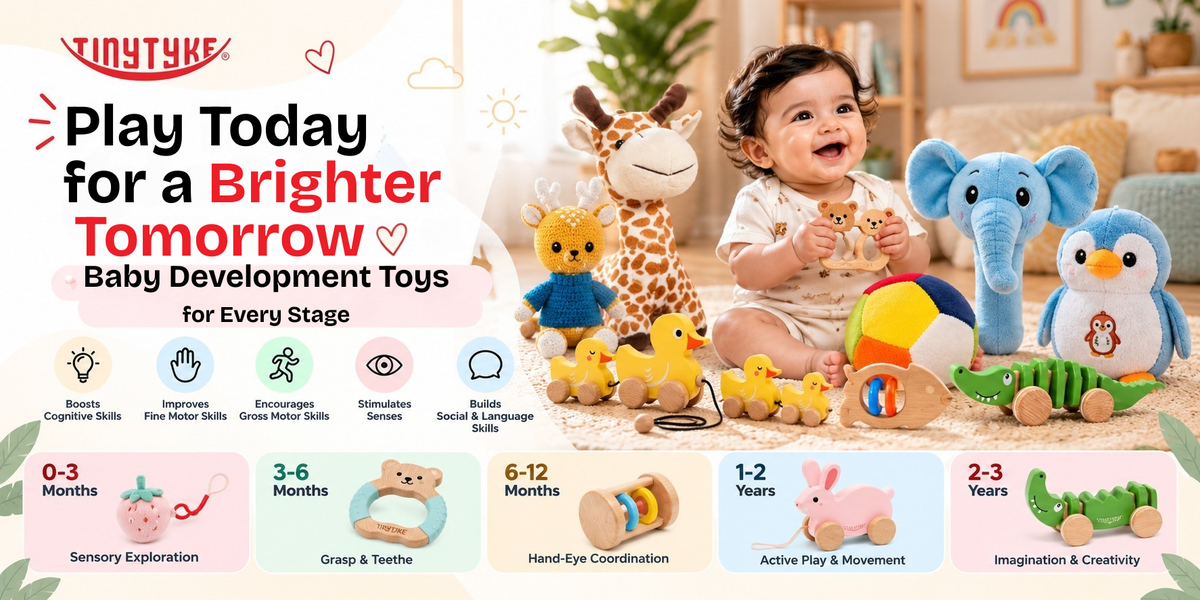
Babies don't need expensive toys to learn.
A simple rattle can encourage a baby to listen and reach. A teether can encourage grasping. A soft animal toy can become part of pretend play. A pull-along toy can encourage a toddler to move, balance and explore.
The best baby development toys are toys that encourage babies to interact, explore, move, communicate and play with their parents or caregivers.
The American Academy of Pediatrics (AAP) recommends choosing toys that match a child's developmental abilities while encouraging new skills. It also highlights traditional toys such as blocks, puzzles, books, pretend-play toys and physical-play toys as valuable for development. HealthyChildren.org
For Indian parents looking for baby development toys in India, the key is not buying the most toys—it is choosing the right type of toy for your baby's current stage.
Quick Answer: What Are the Best Toys for Baby Development?
The best developmental toys depend on your baby's age and current skills.
| Age | Toys to Consider | Skills Encouraged |
|---|---|---|
| 0–3 months | Soft rattles, high-contrast toys, soft sensory toys | Visual tracking, listening, grasping |
| 3–6 months | Rattles, teethers, textured toys | Reaching, grasping, sensory exploration |
| 6–12 months | Activity toys, teethers, stacking toys, soft toys | Hand-eye coordination, problem-solving |
| 1–2 years | Pull-along toys, blocks, pretend-play toys | Walking, coordination, language, imagination |
| 2–3 years | Puzzles, building toys, pretend-play toys | Problem-solving, fine motor skills, creativity |
Remember: children develop at different rates. Toys should support exploration rather than be treated as a test of whether a child has reached a particular milestone.
You can check age-specific developmental milestones through the CDC Developmental Milestones resource. CDC
Table of Contents
- What Are Baby Development Toys?
- Why Are Toys Important for Baby Development?
- 6 Types of Developmental Toys
- Best Baby Development Toys by Age
- Sensory Toys for Babies
- Fine Motor Development Toys
- Gross Motor Development Toys
- Cognitive & Problem-Solving Toys
- Language & Social Development Through Play
- How to Choose Safe Baby Toys
- Do Babies Need Expensive Educational Toys?
- How Parents Can Make Toy Time More Meaningful
- TinyTyke Baby Play & Development Toys
- Frequently Asked Questions
- Final Thoughts
1. What Are Baby Development Toys?
Baby development toys are toys designed or selected to encourage age-appropriate skills through play.
These skills can include:
- Sensory exploration
- Hand-eye coordination
- Grasping
- Fine motor skills
- Gross motor skills
- Problem-solving
- Language development
- Social interaction
- Imagination
- Early cognitive skills
The important word is play.
Your baby doesn't need a toy that promises to "make them smarter."
Instead, look for toys that encourage your child to touch, hold, shake, pull, push, explore, imitate and interact.
The AAP specifically notes that toys should complement play and interaction with caregivers rather than replace them.
2. Why Are Toys Important for Baby Development?
Play gives babies opportunities to practice new skills in a fun environment.
For example:
A rattle
Baby hears a sound → looks toward it → reaches → grasps → shakes it.
That's several developmental experiences from one simple toy.
A teether
Baby sees → reaches → holds → brings it toward the mouth → explores its texture.
A pull-along toy
Toddler grasps → pulls → walks → watches the toy move → repeats the activity.
This is why simple toys can be powerful learning tools.
The CDC describes developmental milestones as skills children demonstrate through how they play, learn, speak, act and move.
3. 6 Types of Baby Development Toys
Instead of choosing toys only by appearance, think about what the toy encourages your baby to do.
1. Sensory Toys
These provide opportunities to explore:
- Texture
- Sound
- Shape
- Colour
- Movement
Examples include rattles, textured teethers and soft sensory toys.
2. Fine Motor Toys
Fine motor skills involve smaller movements of the hands and fingers.
Examples:
- Teethers
- Stacking toys
- Blocks
- Shape sorters
- Simple puzzles
- Toys that encourage grasping and transferring
3. Gross Motor Toys
Gross motor development involves larger body movements.
Examples include:
- Balls
- Push toys
- Pull-along toys
- Movement-based play
- Floor-play activities
WHO recommends that infants have opportunities for physical activity several times throughout the day, particularly through interactive floor-based play. World Health Organization
4. Cognitive Development Toys
These encourage babies and toddlers to experiment and solve simple problems.
Examples:
- Stacking toys
- Shape sorters
- Blocks
- Simple puzzles
- Cause-and-effect toys
5. Language & Social Play Toys
Toys can also encourage communication.
Try:
- Animal toys
- Dolls
- Picture books
- Toy food
- Vehicles
- Pretend-play sets
Instead of simply giving the toy to your child, talk about it.
"Look! It's a dog."
"What sound does a dog make?"
"Can you give Mama the dog?"
This turns ordinary play into an opportunity for interaction.
6. Imaginative Play Toys
As children become toddlers, pretend play becomes increasingly interesting.
A teddy bear can become a "baby."
A toy cup can become part of a pretend tea party.
A toy vehicle can go on an imaginary road trip.
The AAP notes that pretend and symbolic play can support social-emotional development, language and imagination. HealthyChildren.org
4. Best Baby Development Toys by Age
0–3 Months
At this stage, your baby's world is largely about observing, listening and gradually gaining control of their movements.
Good toy choices:
- Soft rattles
- High-contrast visual toys
- Soft sensory toys
- Baby-safe hanging toys
- Cloth books
Focus on:
👀 Visual tracking
👂 Listening
✋ Early grasping
🧠 Sensory exploration
Don't overwhelm your baby with too many toys at once.
A few simple options are enough.
3–6 Months
Your baby may become more interested in reaching, grabbing, putting things in their mouth and exploring textures.
Try:
- Rattles
- Soft toys
- Textured teethers
- Easy-to-grasp toys
- Sensory toys
This is also a great time for interactive floor play.
WHO recommends regular physical activity for infants, including tummy time for babies who are not yet mobile.
6–12 Months
Your baby's curiosity really starts taking off.
They may begin:
- Sitting
- Reaching for objects
- Transferring objects between hands
- Crawling
- Pulling themselves up
- Exploring cause and effect
Helpful toys:
- Teethers
- Soft rattles
- Stacking toys
- Activity toys
- Simple containers
- Balls
- Soft animal toys
At this stage, remember that your interaction is often more valuable than the toy itself.
1–2 Years
Toddlers are ready for more active exploration.
Great development toys include:
- Pull-along toys
- Building blocks
- Simple puzzles
- Balls
- Animal toys
- Pretend-play toys
- Books
Pull-along toys can be particularly fun because they combine movement + coordination + cause and effect.
For example:
Pull → toy moves → toddler watches → walks → repeats.
TinyTyke's play and development collection includes wooden pull-along toys such as rabbit, horse, elephant, duck and crocodile designs intended for children around 1–3 years, along with soft toys and wooden teethers. TinyTyke
Explore TinyTyke Baby Play & Development Toys
2–3 Years
As your child becomes more independent, toys can encourage creativity and problem-solving.
Try:
- Building blocks
- Simple puzzles
- Pretend-play toys
- Drawing materials
- Toy animals
- Vehicles
- Matching games
- Books
At this age, don't worry about making every play activity "educational."
Let your child create their own games.
The CDC's guidance on child-led play emphasizes allowing children to take the lead, which can support independence, confidence and parent-child connection. CDC
5. Sensory Toys for Babies: Why Do They Matter?
Babies learn about their environment through their senses.
A sensory toy might offer:
- Different textures
- Gentle sounds
- Interesting shapes
- Safe colours
- Easy-to-hold surfaces
For example, a soft rattle can encourage your baby to:
Hear → look → reach → hold → shake → listen again.
That's an engaging sensory experience.
However, sensory stimulation doesn't need to be loud or flashy.
In fact, simple toys can encourage deeper interaction.
6. Fine Motor Development Toys
Fine motor skills involve the smaller muscles of the hands and fingers.
Examples of activities include:
- Holding a rattle
- Grasping a teether
- Picking up objects
- Stacking blocks
- Turning pages
- Putting objects into containers
Parent Tip 💡
Don't rush to "teach" your baby how to use a toy.
Place a safe toy nearby and allow your child to explore.
Your role can simply be:
Observe → Encourage → Talk → Let them try.
7. Gross Motor Development Toys
Gross motor development involves movements such as:
- Rolling
- Sitting
- Crawling
- Standing
- Walking
- Running
For babies, floor-based play is particularly important.
WHO recommends interactive floor-based physical activity for infants and regular physical activity throughout the day for young children. World Health Organization
For toddlers, toys such as balls and pull-along toys can encourage movement.
But remember:
The toy should encourage movement—not replace free movement.
8. Cognitive & Problem-Solving Toys
As babies grow, they start discovering:
"If I do this, something happens."
That's the beginning of cause-and-effect learning.
Simple activities can include:
- Putting objects into containers
- Taking them back out
- Stacking
- Sorting
- Building
- Matching
- Finding hidden objects
You don't need complicated electronic toys to encourage these skills.
The AAP notes that traditional toys such as blocks, shapes and puzzles can support problem-solving, fine motor skills and early cognitive development. HealthyChildren.org
9. Language & Social Development Through Play
One of the best "development toys" is actually you. ❤️
When playing with your baby:
Describe what they're doing
"You're holding the giraffe!"
Copy them
If they shake the toy, shake yours too.
Add words
"Shake, shake, shake!"
Ask simple questions
"Where is the elephant?"
Sing songs
Songs combine:
🎵 Language
👂 Listening
🤝 Interaction
😊 Emotion
WHO also encourages talking, reading, storytelling, singing and interactive engagement with young children. World Health Organization
10. How to Choose Safe Baby Development Toys
Developmental benefits are important—but toy safety comes first.
Before buying a toy, check:
✔ Age recommendation
Choose toys appropriate for your child's age and abilities.
✔ Small parts
Avoid toys containing small parts that could create a choking risk.
✔ Batteries and magnets
The AAP specifically advises caution with button batteries and high-powered magnets. HealthyChildren.org
✔ Construction
Check for:
- Loose pieces
- Sharp edges
- Broken parts
- Loose stitching
- Damaged surfaces
✔ Supervision
Some toys require closer adult supervision than others.
✔ Cleaning
Babies often put toys in their mouths, so choose materials that can be cleaned according to the manufacturer's instructions.
11. Do Babies Need Expensive Educational Toys?
No.
A toy does not have to be expensive or electronic to be useful.
A simple wooden toy can encourage:
- Grasping
- Walking
- Coordination
- Imagination
- Problem-solving
A soft animal can encourage:
- Naming
- Storytelling
- Pretend play
- Emotional connection
A cardboard box can become:
🚗 A car
🏠 A house
📦 A storage box
🚂 A train
The AAP emphasizes that expensive or highly electronic toys aren't necessary for development and that interaction with parents and caregivers remains essential. HealthyChildren.org
12. How Parents Can Make Toy Time More Meaningful
You don't need to plan a complicated activity every day.
Try the 10-minute play idea.
Put away distractions and spend 10 minutes following your child's lead.
For babies:
- Shake a rattle.
- Talk about the sound.
- Offer a teether.
- Sing.
- Practice tummy time when appropriate.
For toddlers:
- Pull a toy together.
- Build a tower.
- Name animals.
- Read a picture book.
- Pretend to feed a teddy.
The goal isn't:
"How many skills did my baby learn today?"
The goal is:
"Did my baby have an opportunity to explore and connect?"
TinyTyke Baby Play & Development Toys
At TinyTyke, we believe play should be simple, engaging and meaningful for growing little ones.
The TinyTyke Baby Play & Development collection brings together different types of toys for babies and toddlers, including soft plush toys, rattles, wooden teethers and pull-along toys. The collection is designed around different stages of sensory exploration, coordination and active play. TinyTyke
Shop TinyTyke Baby Play & Development Solutions
Some options parents can explore include:
🧸 Soft & Plush Toys
Great for cuddling, sensory exploration and early pretend play.
🦷 Wooden Teethers
Designed for little hands to hold and explore during the teething stage.
🐰 Pull-Along Toys
Suitable for growing toddlers who are developing walking confidence, coordination and active play skills.
The goal isn't to have a room overflowing with toys.
Choose a few age-appropriate toys and give your child plenty of time to explore them.
Baby Development Toys: A Simple Age-Based Shopping Checklist
Before buying another toy, ask:
For a newborn:
☐ Is it soft and age appropriate?
☐ Does it encourage looking or listening?
☐ Is it easy to clean?
For a 3–6 month old:
☐ Is it easy to grasp?
☐ Does it offer interesting textures or sounds?
☐ Is it safe for mouthing?
For a 6–12 month old:
☐ Does it encourage reaching and transferring?
☐ Can baby explore it independently while supervised?
☐ Does it encourage movement?
For a 1–2 year old:
☐ Does it encourage walking or movement?
☐ Does it support simple problem-solving?
☐ Can parents use it for language and pretend play?
For toddlers:
☐ Does it encourage creativity?
☐ Can the child use it in different ways?
☐ Does it encourage active or social play?
Frequently Asked Questions About Baby Development Toys
What are the best development toys for babies?
The best toys are age-appropriate toys that encourage babies to explore, move, grasp, listen, interact and communicate. Rattles, teethers, soft toys, simple activity toys and age-appropriate floor-play toys can all have a role.
Which toy is best for a 6-month-old baby?
At around 6 months, babies often enjoy easy-to-grasp rattles, teethers, textured toys and simple sensory toys. Always choose toys appropriate for the child's individual abilities and supervise play.
What are the best toys for a 1-year-old baby?
For a 1-year-old, consider pull-along toys, blocks, balls, simple puzzles, soft animal toys and pretend-play toys. Choose options that encourage movement, coordination and interaction.
Are wooden toys good for baby development?
Wooden toys can be excellent developmental play options when they are age-appropriate, well-made and free from hazardous small parts or sharp edges. Simple wooden toys can encourage grasping, coordination, problem-solving and active play.
Do babies need educational toys?
No. Babies do not need expensive electronic or highly marketed "educational" toys to develop. Simple toys combined with interaction, talking, movement and play can provide valuable learning opportunities. HealthyChildren.org
How many toys should a baby have?
There is no recommended number of toys. A small selection of age-appropriate toys can be enough. Rotating toys can also help keep familiar toys interesting without constantly buying new ones.
Can toys help a baby reach developmental milestones?
Toys can provide opportunities to practice skills, but no individual toy guarantees a developmental milestone. Development happens through a combination of play, movement, interaction, relationships, nutrition, sleep and individual development.
Should babies play with electronic toys?
Electronic toys aren't necessary for healthy development. Whenever possible, prioritize toys that encourage hands-on exploration and interaction with parents or caregivers. The AAP recommends choosing toys that support development without replacing human interaction. HealthyChildren.org
Final Thoughts: The Best Toy Is One Your Baby Wants to Explore ❤️
Choosing baby development toys doesn't need to be complicated.
You don't need the biggest toy collection.
You need opportunities for your baby to:
Touch.
Look.
Listen.
Reach.
Move.
Explore.
Imagine.
And connect with you.
A simple rattle can become a sensory lesson.
A teether can become a grasping activity.
A pull-along toy can become a walking adventure.
And a soft toy can become a new best friend.
Most importantly, remember that you are your baby's most important play partner.
Choose age-appropriate toys, create a safe play environment, follow your child's interests and enjoy the little moments along the way.
Trusted External Resources
For parents who want to learn more about child development and play:
- American Academy of Pediatrics – Toy Buying Tips HealthyChildren.org
- CDC – Developmental Milestones CDC
- CDC – Tips for Child-Led Play CDC
- WHO – Physical Activity, Sedentary Behaviour and Sleep Guidelines World Health Organization
- WHO – Engaging and Having Fun With Young Children World Health Organization